
Why Commercial Construction in Ontario's Growing Communities Requires a Different Mindset
6 Min Read
Construction
Learn why commercial construction projects in Ontario's growing communities require different planning, logistics, communication, and execution strategies for landlords, developers, retail brands, and restaurant operators.
Why Commercial Projects in Ontario's Growing Communities Require a Different Mindset
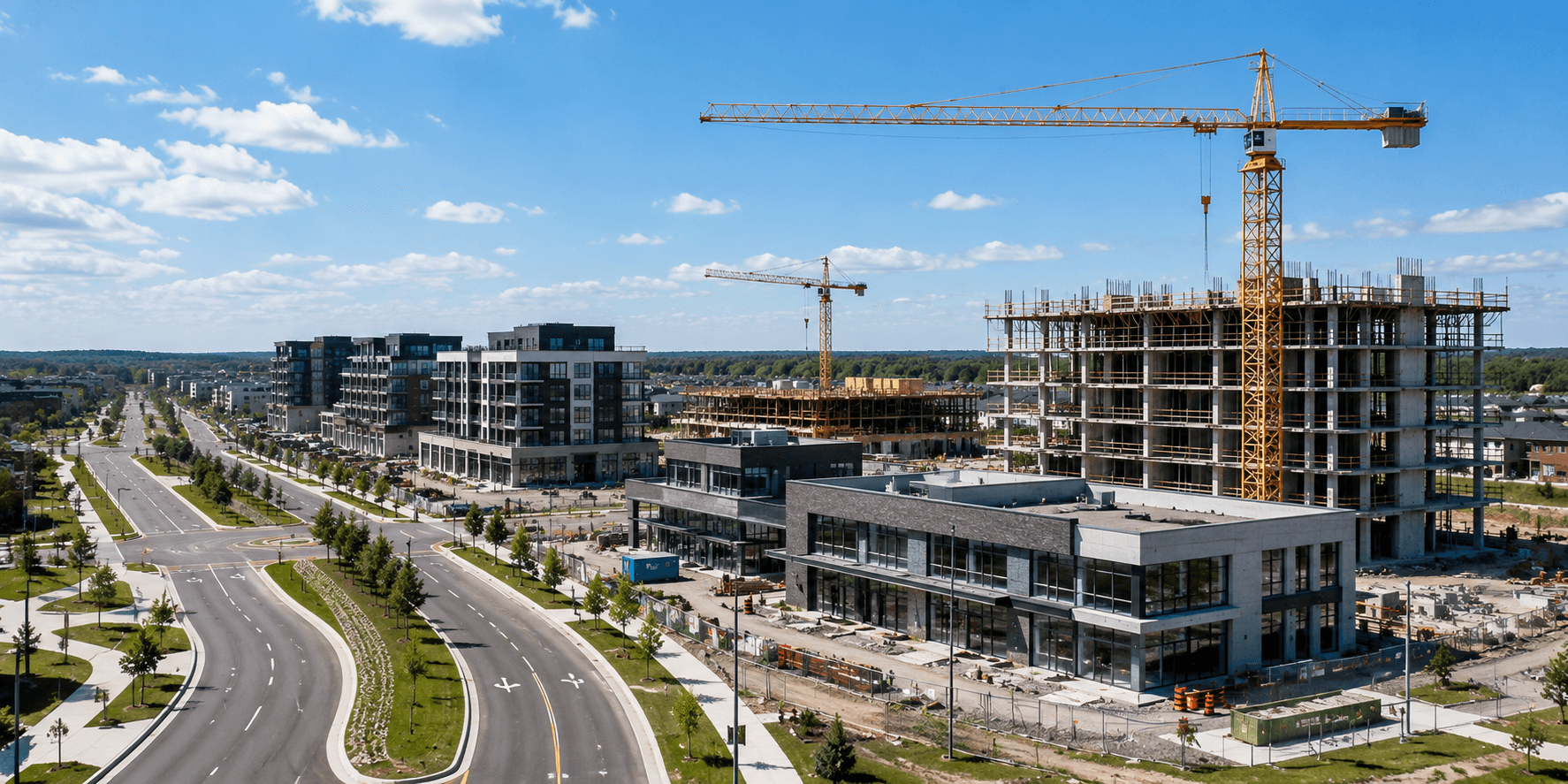
When people think about commercial construction in Ontario, they often picture downtown Toronto skylines, busy intersections, and large urban developments.
But some of the most demanding commercial projects are not happening in Canada's biggest cities.
They are happening in Ontario's growing communities.
Communities like Shelburne, Alliston, Innisfil, Bradford, and many others are experiencing rapid growth, and several factors are driving demand in these markets. New restaurants, retail spaces, medical clinics, service businesses, and commercial developments are arriving to meet the needs of expanding populations and the need for more commercial spaces.
From the outside, these commercial buildings may appear smaller than those in major cities.
From a construction perspective, however, they often require even more thoughtful planning, stronger project management, and a different approach to execution.
The challenges are different.
And because they are different, the mindset needs to be different too.
Growth Brings Opportunity to Large Scale Commercial Projects. It Also Brings Complexity and Value Engineering.
Growing communities offer tremendous opportunities for businesses looking to expand.
Land is often more available.
New residential developments continue to attract families and add pressure for stronger housing supply.
Retail demand increases as populations grow.
National restaurant brands begin looking for new locations.
Increasing housing supply is also one of the local drivers behind new commercial demand.
For developers, landlords, retail brands, consultants, and each business owner involved, this creates exciting possibilities.
For construction teams, it introduces a different set of responsibilities across Ontario's commercial construction sector and the broader commercial sector.
Success is no longer measured simply by completing the building.
It is measured by how well every part of the project is planned before construction even begins.
That is where value engineering becomes essential. Every design decision, construction method, and material selection should be evaluated early, with material costs reviewed up front, to control cost and overall cost while maintaining quality, functionality, compliance, and long term performance.
Planning in the Commercial Construction Process Starts Long Before the First Excavator Arrives
One lesson we continue to see is that construction does not begin when equipment arrives on site, and several factors shape the work before it starts.
It begins months earlier.
Planning includes understanding local infrastructure and transportation infrastructure, coordinating with municipalities, reviewing servicing requirements, confirming utility availability, scheduling inspections and making sure permits are approved, planning material deliveries, identifying potential risks before they become problems, addressing building code compliance and code compliance for fit-outs, confirming zoning allows the intended business operation, and aligning landlord and property requirements with the project concept.
Every decision made during planning has an impact on construction, with ground conditions being one of the elements that can affect timeline and scope.
Permanent commercial leases often involve costs beyond base rent, so early planning must account for the full budget while also providing valuable insights through early review.
Strong planning creates confidence through research, knowledge, and expertise in compliance.
Poor planning creates uncertainty.
The strongest commercial construction projects are often the ones where potential problems are identified long before construction begins.
Infrastructure and Code Compliance Look Different Outside Major Cities
Each community has its own characteristics, and permit or inspection timelines can differ across the province, not just from one city to another.
Inspection schedules may differ.
Material suppliers may be farther away. In smaller communities, trade availability and subcontractors can also affect coordination.
Trade availability may vary, so effective allocation of resources is what keeps completion on time. Even outside major centres, planning standards, compliance expectations, and safety standards still need to align with Canada requirements.
Delivery routes can affect scheduling.
Emergency services may not be located minutes from the project.
These are not obstacles.
They are planning considerations.
Experienced project teams recognize these realities early and build them into the project strategy with a clear focus on logistics and scheduling instead of reacting to them later, protecting efficiency from avoidable delays.
In Toronto area commercial work, timelines often range from 8 weeks to 5 months, though communities outside major cities can add logistical variables that should be considered during planning for large scale commercial projects as well.
Understanding these differences allows commercial construction teams to build more realistic schedules while maintaining quality and reducing unnecessary risk across sites with unique challenges that affect realistic scheduling.
Emergency Planning Is Part of Good Construction Planning
One observation from a recent commercial project reminded our team of something important.
The nearest hospital with emergency services was significantly farther away than what many projects inside the Greater Toronto Area would typically experience.
That did not create concern.
It created responsibility.
Emergency contacts, communication procedures, site orientation, and safety planning became even more important.
Construction is about preparing for situations you hope never happen.
Good planning means thinking beyond the drawings and considering the people working on site every day.
Emergency preparedness should never be viewed as an afterthought. It is part of responsible commercial construction planning.
Communication Becomes Even More Important
Commercial construction projects bring together many different groups, including clients and owners, and some larger companies also rely on in-house teams alongside external consultants.
Landlords.
Retail brands.
Restaurant operators.
Consultants.
Interior designers.
Architects.
Engineers.
Municipal officials.
A dedicated contractor or project manager.
Suppliers.
Office users and fit-out stakeholders may also be part of the process.
When projects take place in growing communities, transparent communication becomes even more valuable because it supports coordination and client satisfaction.
Project management depends on professional communication, clear expectations, and access to the right specialists.
Questions need answers quickly.
Site conditions change.
Schedules evolve.
Landlord approvals and tenant coordination often shape timelines in retail spaces.
Keeping everyone aligned helps projects continue moving forward with confidence and helps teams manage expectations across stakeholders.
The more stakeholders involved, the more valuable structured communication becomes throughout the entire construction process.
Communication Becomes Even More Important
Communication Becomes Even More Important
Commercial construction projects bring together many different groups, including clients and owners, and some larger companies also rely on in-house teams alongside external consultants.
Landlords.
Retail brands.
Restaurant operators.
Consultants.
Interior designers.
Architects.
Engineers.
Municipal officials.
A dedicated contractor or project manager.
Suppliers.
Office users and fit-out stakeholders may also be part of the process.
When projects take place in growing communities, communication becomes even more valuable because it supports coordination and client satisfaction.
Project management depends on professional communication, clear expectations, and access to the right specialists.
Questions need answers quickly.
Site conditions change.
Schedules evolve.
Landlord approvals and tenant coordination often shape timelines in retail spaces.
Keeping everyone aligned helps projects continue moving forward with confidence.
The more stakeholders involved, the more valuable structured communication becomes throughout the entire construction process.
Execution and Project Management: Where Planning Becomes Reality
Construction involves moving parts across different sectors, from retail stores and office complexes to warehouses.
Schedules shift.
Deliveries change.
Unexpected conditions appear.
The difference is rarely the challenge itself.
The difference is how the project team responds.
Execution is the ability to make informed decisions throughout the construction process, communicate clearly, maintain quality, and keep the project moving without losing sight of the details or the performance of core structures, whether the work involves commercial or institutional projects, new environments, or fit-outs tailored to specific business needs, with office construction increasingly centered on high-quality, specialized development for technology and health users and with architectural, engineering, and layout decisions supported by innovative solutions.
Tenant improvements and interior build-out construction commonly adapt existing spaces for new tenants, and renovation teams often develop each scope around compliance, function, and brand needs.
Some teams also handle industrial construction for operational facilities such as warehouses. Data center construction is also expanding quickly in Ontario because of technological demand and AI integration.
Factories are another example of projects that demand durable planning and disciplined execution.
In retail spaces, execution also means supporting customer flow and visual branding through practical innovation.
Successful project management combines planning, communication, quality control, and adaptability. Life sciences and specialized laboratory facilities are a high-growth niche in Ontario's commercial construction sector. Office retrofits and laboratory facilities are leading investment activity in Ontario's commercial construction sector.
That is where teams with decades of experience and a strong record of completed work tend to separate themselves, especially when clients want a fully licensed contractor as project complexity and compliance expectations increase.
A Community Deserves More Than Just Another Building
Every commercial project becomes part of the community around it.
A new restaurant supports job creation.
Commercial and residential construction often grow together in communities shaped by ongoing development.
These projects also help support the local economy: in January 2025, Ontario’s non-residential sector reached $6.7 billion in investment, up 0.8% from the same period, while Ontario’s commercial construction total investment reached $22.1 billion. Industrial projects received $1.5 billion in January 2025, and institutional projects saw $2.0 billion, reinforcing how multiple sectors support local growth.
A retail stores project brings new services.
A commercial plaza supports local businesses, with office buildings often part of the mix in growing communities; office investment remains concentrated in major markets such as the Toronto CMA, while activity is also strong in centers like Mississauga, where a new district energy project reflects the sustainability direction shaping some Ontario developments. The commercial component increased by $16.3 million in January 2025.
In Toronto, renovation costs commonly range from $100 to $150 CAD per square foot, which is why long-term community value depends on thoughtful planning and execution. Interest rate volatility can affect commercial project feasibility.
Construction is not simply about completing a building.
Sustainable practices are increasingly integrated into retail construction so commercial properties can better serve community life, while residential construction can also shape nearby demand.
Eco-friendly building practices, including energy-efficient systems and sustainable materials, reduce environmental impact and support operational efficiency.
It contributes to the growth and broader commercial development of the community itself, whether the project is a retail space or a specialized facility designed to meet the needs of a specific industry and create a great place for business while protecting your investment through quality and technology.
Standards such as LEED certification and other green building certifications help guide compliance with sustainability standards.
Every successful commercial project should create long term value not only for the client, but also for the community it serves and support long-term expansion.
That perspective changes how projects should be approached, with a high degree of professionalism, excellence, and clear maintenance expectations after completion.
