
How Long Does Commercial Construction Really Take in Ontario?
6 Min Read
Construction
One of the first questions every landlord, developer, retail brand, and restaurant owner asks is, “How long will this project take?” The honest answer is that no two commercial construction projects follow the same timeline. A restaurant fit-out, retail renovation, office build-out, or new commercial development each comes with different approvals, design requirements, permit reviews, procurement schedules, and construction activities. In Ontario, successful projects are measured not by how quickly construction starts, but by how well the project is planned before work begins.
How Long Does Commercial Construction Really Take in Ontario?
Quick Answer
One of the first questions every landlord, developer, retail brand, and restaurant owner asks is, “How long will this project take?”
The honest answer is that no two commercial construction projects follow the same timeline.
A restaurant fit-out, retail renovation, office build-out, or new commercial development each comes with different approvals, design requirements, permit reviews, procurement schedules, and construction activities.
In Ontario, successful projects are measured not by how quickly construction starts, but by how well the project is planned before work begins.
Every Project Has Its Own Timeline
Many people expect commercial construction to follow a fixed schedule.
Unfortunately, commercial construction doesn't work that way.
Two projects with similar square footage can have completely different timelines.
Why?
Because every project has different variables.
A restaurant requires commercial kitchen coordination.
A medical clinic has specialized mechanical and plumbing systems.
Retail spaces must often comply with landlord design criteria.
Office renovations may require phased construction while the business remains operational.
The timeline is never determined by size alone.
It is determined by complexity.
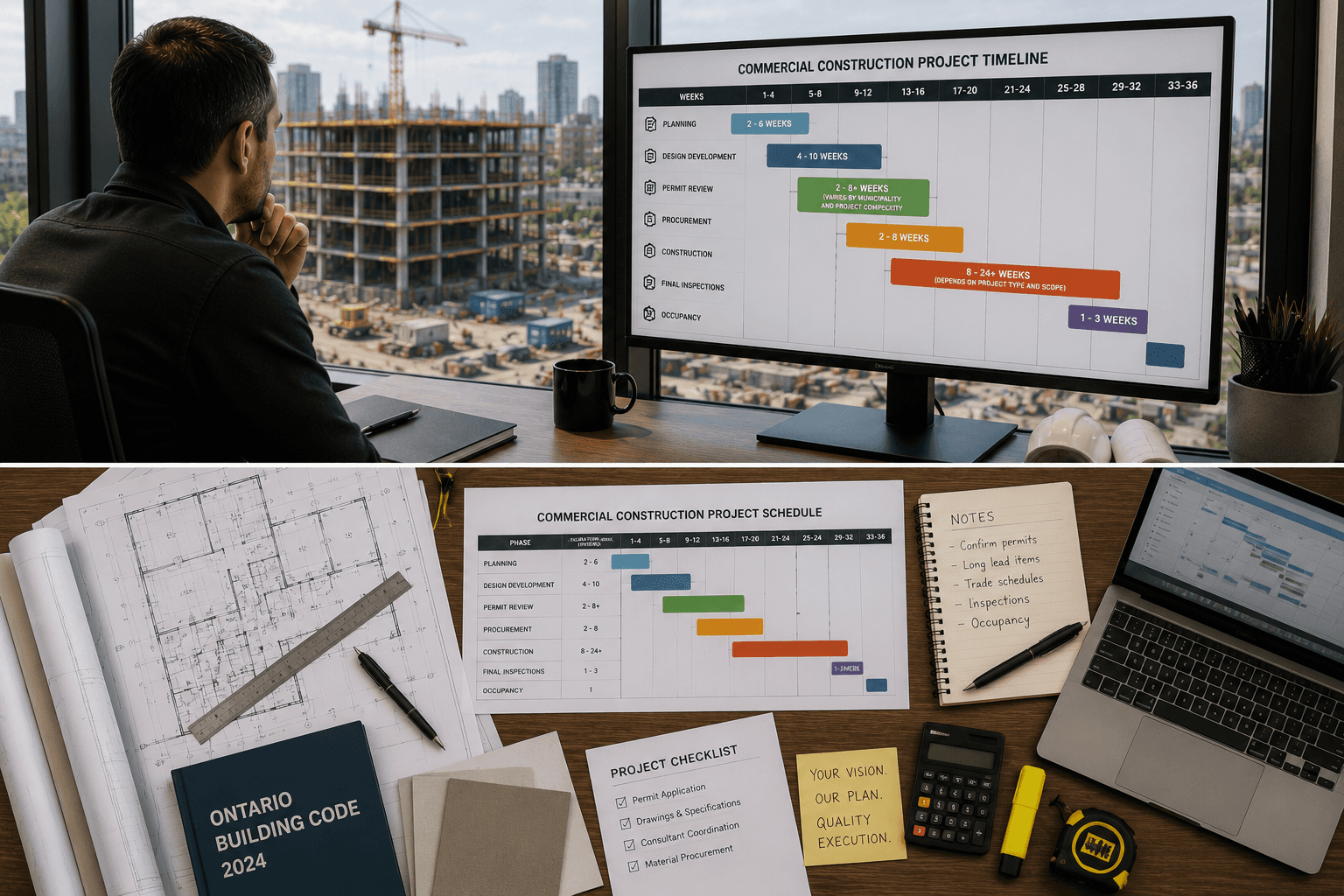
The Six Stages of a Commercial Construction Project
Although every project is different, most commercial construction projects in Ontario follow a similar sequence.
1. Planning and Project Management
This includes project goals, budgeting, value engineering techniques used during fit-outs to optimize project budgets, consultant coordination, site investigation, feasibility, and engineering.
Typical duration:
2 to 6 weeks
2. Design Development with Independent Consultants
Architects and engineers prepare drawings while coordinating structural, mechanical, electrical, plumbing, accessibility, and fire protection requirements.
Typical duration:
4 to 10 weeks
3. Permit and Lease Agreement Review
Once a complete application is submitted, municipalities review the project for Building Code compliance, applicable laws, and whether it can operate within municipal rules and other legal requirements before approval.
Ontario's Building Code establishes prescribed review periods for complete applications, but the overall timeline depends on the municipality, project complexity, and whether revisions are required.
Typical duration:
2 to 8 weeks or longer
4. Procurement
Materials are ordered.
Trades are scheduled.
Equipment is coordinated.
Long-lead items such as rooftop units, electrical equipment, storefront glazing, and custom millwork are often ordered early to reduce delays.
Typical duration:
2 to 8 weeks
5. Construction
This is the stage most people recognize.
Demolition.
Framing.
Mechanical.
Electrical.
Plumbing.
Drywall.
Flooring.
Millwork.
Painting.
Final finishes.
Some commercial construction projects also span hospitality, child care, pharmaceutical, and religious spaces, and each part of the industry comes with different requirements: hospitality work supports customer experience, pharmaceutical builds must meet rigorous safety standards, child care projects account for safety, design, and health, and religious spaces should reflect community beliefs and values with consistent quality.
Typical duration:
8 to 24 weeks or longer, depending on project type and scope.
Some projects also prioritize sustainable construction with eco-friendly materials and waste reduction strategies to reduce environmental impact and improve energy efficiency.
6. Final Inspections and Occupancy
Before opening, the project must complete inspections, deficiency corrections, and occupancy requirements where applicable.
Typical duration:
1 to 3 weeks
What Causes Construction Timelines to Change?
One of the biggest misconceptions is that construction delays happen only because of weather.
In reality, timelines are influenced by many different factors.
Some of the most common include:
Permit review comments
Owner-requested changes
Material lead times
Utility coordination
Existing site conditions
Landlord approvals
Municipal inspections
Specialty equipment availability
Sustainability requirements, which can affect schedules when retail projects pursue LEED certification or other eco-friendly solutions and require additional coordination, approvals, or project resources
Consultant revisions
Sustainable retail construction practices can minimize environmental impact, and LEED certification promotes sustainable building practices while ensuring high environmental standards in retail spaces; in some cases, retail construction integrates eco-friendly solutions into projects that help LEED-certified buildings save up to 30% in energy costs.
Most schedule changes occur because several small factors combine throughout the project.
Can Construction Start Before a Permit Is Issued?
This is another common question.
In most cases, no.
Under Ontario's Building Code Act, a building permit is generally required before construction begins, except for certain types of work that are specifically exempt under the legislation.
Starting work without the required permit can lead to stop-work orders, additional costs, delays, and potential legal consequences.
Obtaining the proper approvals before construction begins provides legal protection, helps clarify who is responsible before work starts, and supports compliance with the law for everyone involved in the project.
Why Some Projects Finish Faster Than Others
It isn't always because the contractor works faster.
Projects finish on time because they begin with realistic expectations.
Clear drawings.
Complete permit applications.
The right location decisions and early planning help companies expand more efficiently.
Strong communication.
Accurate scheduling.
Consistent project management that coordinates contractors and support services.
Successful commercial construction is rarely the result of rushing.
It is the result of preparation.
Ontario Construction Fact for Business
Did you know?
Commercial construction timelines often depend on activities that happen before construction even begins.
In retail construction, each store location can tell a bigger story beyond the products on shelves and shape the timeline before work even starts.
Planning, consultant coordination, permit reviews, procurement, and scheduling can account for a significant portion of the overall project timeline.
Projects that invest time during these early stages are often better positioned to reduce delays during construction.
Field Insight
One lesson we've learned through years of professional commercial construction expertise is that clients often focus on the construction phase because that's when visible progress begins.
However, some of the most important work happens long before anyone steps onto the site.
A well-planned project may appear slower during the early stages, but that investment in planning often results in fewer surprises, helps maintain quality through the process, and leads to better coordination and a smoother construction process.
The projects that finish on time usually aren't the ones that start the fastest.
They're the ones that start the smartest.
Final Thoughts
Every commercial construction project has its own challenges, timeline, and priorities.
Rather than asking, “How fast can construction start?”, a better question is:
“How well is the project being prepared?”
At VOK Construction Group, we believe successful projects are built on realistic planning, coordinated execution, clear communication, and practical innovation from the very beginning, with our organization focused on delivering high-quality commercial construction.
Because in commercial construction, the timeline isn't just about speed.
It's about delivering the project safely and efficiently, with confidence for businesses across Ontario.
