
Why Utility Coordination Can Make or Break a Commercial Construction Project
5 Min Read
Construction
In this article, a commercial space means a retail, restaurant, office, or mixed-use property being built or fit out for occupancy and one of the biggest factors in whether it opens on time is utility coordination. For business owners, brand operators, franchise teams, project managers, consultants, landlords, and other stakeholders planning a new location in Ontario, this quick read explains how scheduling hydro, gas, water, internet, and fire services affects construction timelines, where delays typically happen in growing communities, and how communication between utility providers, contractors, and decision-makers keeps a finished space from sitting unusable past handover.
Why Utility Coordination and Project Management Can Make or Break a Commercial Construction Project
Quick Answer
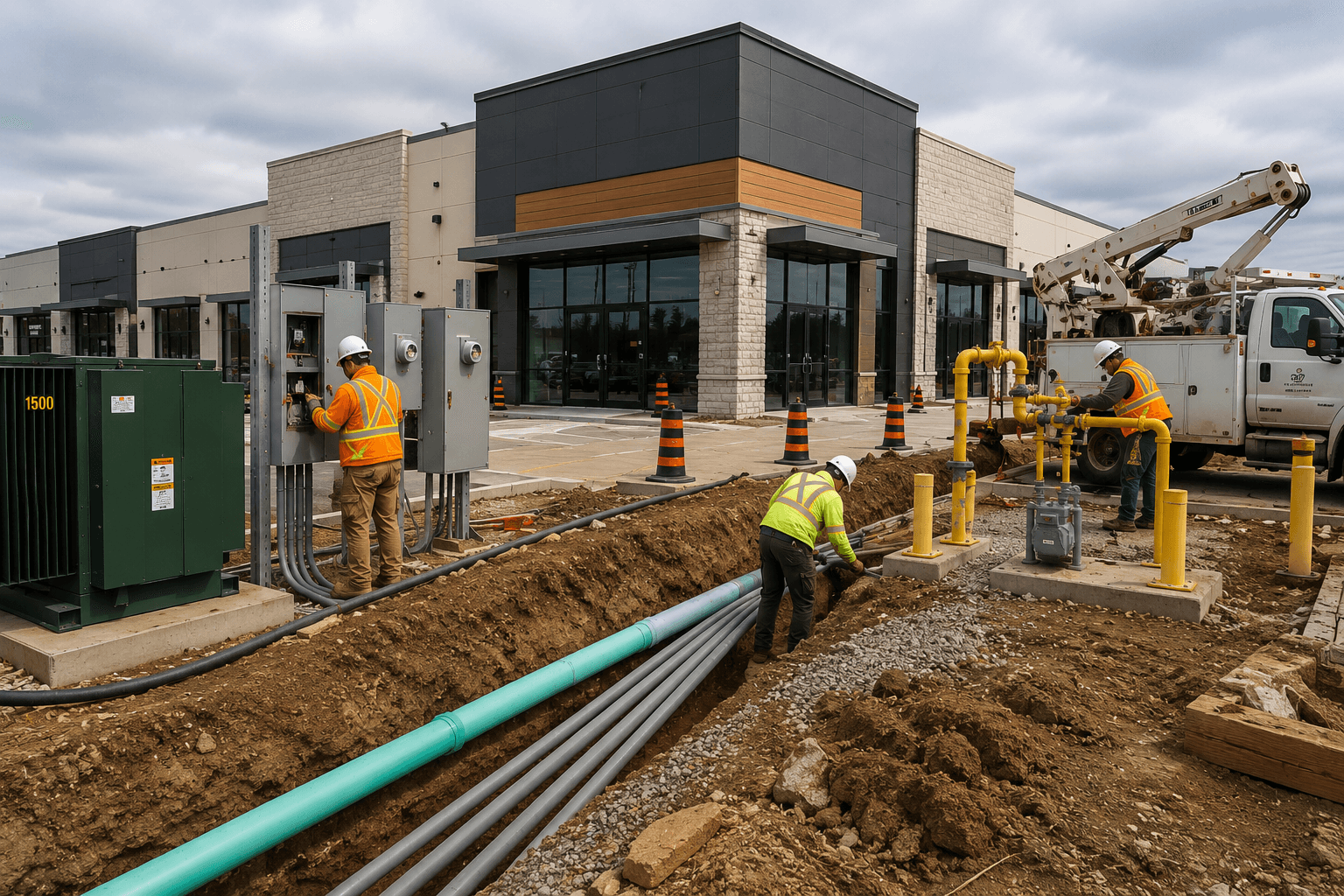
Many commercial construction projects are completed on schedule, yet businesses still cannot open because utilities are not fully coordinated. Electricity, natural gas, water, sanitary sewer, telecommunications, fire alarm monitoring, and other essential services all require planning, approvals, inspections, and coordination with multiple service providers. Successful commercial construction projects begin utility planning long before the building is ready for occupancy.
A Finished Building Doesn't Always Mean Retail Locations Are Ready to Open
When most people think about commercial construction, they imagine the moment the walls are painted, the flooring is installed, and the final fixtures are in place.
From the outside, the project appears complete.
But construction isn't finished simply because the building looks finished, especially in a commercial space built for retail sales, food services, or professional services.
A restaurant cannot operate without gas.
A retail store built for direct customer interaction and sales cannot process transactions without reliable internet.
HVAC systems cannot be commissioned without electrical service.
Fire alarm systems cannot be fully activated until required connections and testing are complete.
Occupancy depends on more than construction.
Businesses leasing a commercial space must also evaluate location, total costs, and negotiated lease terms, including any tenant inducements, before opening.
It depends on coordination.
Utility Coordination Starts Earlier Than Most People Think
One of the biggest misconceptions in commercial construction is that utility companies become involved near the end of the project.
In reality, coordination often begins months before construction is complete.
Commercial properties are categorized by their primary function.
Commercial space comes in different forms, including storefronts, office buildings, and mixed-use buildings.
There are other types as well; mixed-use properties combine two or more commercial types, and some multi-family residential properties are also considered commercial real estate.
Commercial projects may require coordination with:
Local electricity providers
Natural gas utilities
Municipal water and sanitary services
Stormwater connections
Telecommunications providers
Internet service providers
Fire alarm monitoring companies
Security system providers
Each organization follows its own application process, scheduling requirements, and inspection procedures.
These timelines don't always align automatically.
Someone needs to coordinate them.
Every Utility Has Its Own Timeline
Unlike construction activities managed by a general contractor, utility providers operate independently. Commercial lease terms are often longer and more complex than many business owners expect, which is why early utility coordination matters from the start.
Electrical service upgrades may require engineering review.
Gas connections often require scheduling and field inspections.
Internet installation depends on existing infrastructure and provider availability.
Water service activation may require municipal inspections.
Fire alarm monitoring cannot be completed until testing requirements have been satisfied.
Because each provider follows a different process, utility coordination should be treated as part of the overall project schedule rather than an item left until the end. Whether you are leasing for flexibility, lower upfront capital needs, and tighter budget control or purchasing for long-term financial benefits and greater control over renovations, early utility scheduling remains essential.
Growing Communities Present Additional Challenges
Projects located in Ontario's growing communities often require even more careful coordination, especially as businesses expand into a new commercial space where access to main roads or transport links can affect servicing timelines; in the GTA, proximity to major transportation infrastructure such as Toronto Pearson International Airport, Canada's largest airport, can also shape site planning and servicing coordination.
New commercial developments may involve expanding municipal infrastructure.
Electrical capacity may require upgrades.
Natural gas servicing may need to be extended.
Internet providers may still be developing service in newer commercial areas.
Visibility, parking, and the type of commercial use also influence site suitability, particularly where local regulations distinguish between lighter and heavier commercial uses in a city or surrounding town context.
Emergency response requirements and municipal servicing standards may also differ between communities.
These are not problems.
They are planning considerations.
Understanding them early allows project teams to build realistic schedules and reduce unexpected delays.
Communication Keeps the Project Moving
Utility coordination is one of the clearest examples of why communication matters in commercial construction.
Owners.
Consultants.
Municipal officials.
Utility providers.
Equipment suppliers.
Landlords.
Project managers.
Every group plays a role, and strong collaboration keeps clients, consultants, landlords, utility providers, and other stakeholders aligned.
A missed email.
A delayed inspection.
An incomplete application.
Or a forgotten utility request can affect the entire project schedule.
Good communication protects momentum. It also strengthens project management, supports budget control, and helps teams use internal and external resources more effectively. That makes it easier to assess issues early, establish the objective, and let the right people lead decisions before delays escalate. Proactive budget management helps prevent unexpected cost overruns, and value engineering can optimize budgets using internal and external data.
Utility Planning Protects Opening Day
For many businesses, commercial space is meant to generate profit, so construction is only part of the overall investment and delays carry direct financial consequences.
Restaurants coordinate staff training.
Retail stores receive inventory.
For example, in Toronto, major destinations such as Square One, home to over 330 retail stores, and Yorkdale Shopping Centre, with 270 stores and restaurants, operate at a scale where opening-day readiness depends on precise coordination.
Franchise operators schedule grand openings.
Marketing campaigns begin weeks before opening.
Lease obligations continue regardless of whether the business is operating.
When utility coordination falls behind, the impact extends far beyond construction.
Proper planning helps businesses open with confidence and greater efficiency on the path to opening day.
Ontario Construction Fact
Did you know?
Many utility connections for commercial developments are coordinated through independent utility providers rather than the municipality itself. Depending on the project location and servicing requirements, applications, engineering reviews, inspections, or infrastructure upgrades may be required before permanent services can be activated. These activities often run alongside construction rather than after it.
Field Insight
One lesson we've learned is that utility coordination is most successful when it becomes part of the project's critical path from the very beginning.
Utility planning also varies by use type: office projects benefit from detailed coordination that supports employee satisfaction and productivity, restaurant builds depend on an efficient kitchen layout and equipment selection, hospitality spaces must support smooth front- and back-of-house flow, healthcare facilities such as hospitals and clinics need layouts that improve patient flow and support health requirements, child care construction must meet strict licensing requirements, pharmaceutical construction demands rigorous safety protocols, and religious building construction requires an understanding of the values that shape each community and industry expectation.
Waiting until the building is nearly complete to coordinate permanent services often creates unnecessary pressure on the project schedule.
The most successful commercial projects treat utilities as part of construction planning, not as the final step before opening.
Final Thoughts
Commercial construction is about much more than building walls and installing finishes; fit-out work is what makes a commercial space fully operational for retail, hospitality, and day-to-day use.
In those environments, fit-out services often cover design, construction, and maintenance, while also ensuring compliance with building codes and regulations.
Successful projects depend on hundreds of coordinated activities working together.
Utility coordination is one of the most important.
At VOK Construction Group, we believe that careful planning extends beyond the construction site.
By coordinating utilities, approvals, inspections, and project schedules early, commercial projects are better positioned to move from construction to occupancy with fewer surprises, while retail construction also strengthens customer experience and brand storytelling.
Sustainable construction practices that use eco-friendly, quality materials and certifications such as LEED can reduce environmental impact, support long-term durability, and lower operating costs over time.
Because a building isn't truly complete until it's fully connected, fully operational, and ready to welcome customers.
