
Why Retail Fitouts Fail Before Construction Even Starts
7 Min Read
Construction
Most retail fitouts in Ontario fail not because of bad construction, but because of poor planning before a single wall goes up. This article breaks down the real reasons fitouts run over budget and miss opening dates, from landlord approval delays and permit timelines to TI allowance gaps and the wrong contractor for the environment. A practical guide for retail tenants, franchise operators, fast food brands, mall landlords, and commercial consultants who want to open on time and on budget.
Why Retail Fitouts Fail Before Construction Even Starts
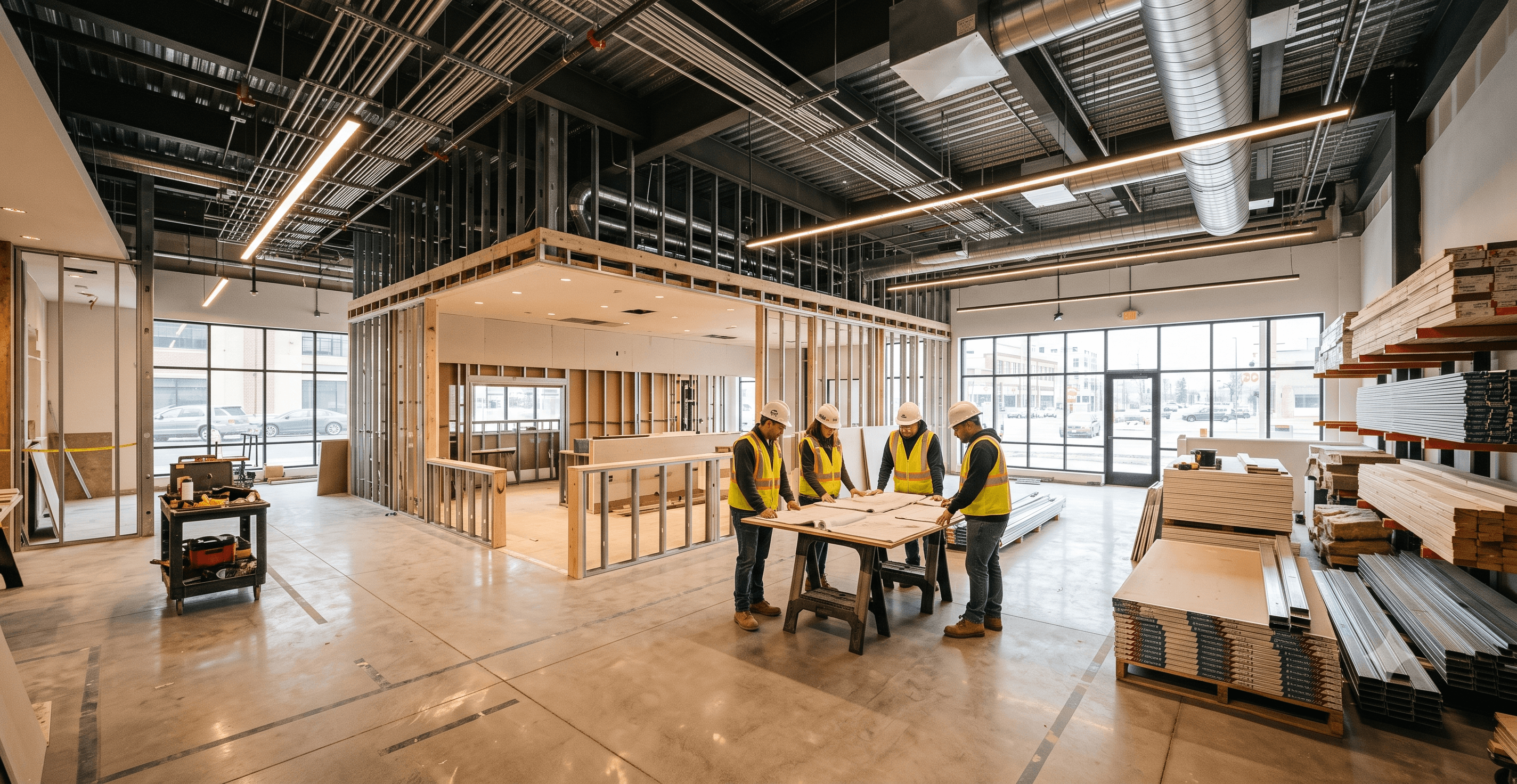
Why Retail Fitouts Fail Before Construction Even Starts
A Guide for Tenants, Franchises and Landlords in Ontario
Every year, retail tenants, franchise operators, and fast food brands across Ontario sign leases, hire designers, and begin planning their new spaces with a clear opening date in mind.
Many of them miss it.
Not because of bad contractors. Not because of material shortages. Not because of anything that happened during construction.
Because of decisions made, and not made, before a single wall went up.
The fitout process in Ontario's retail and commercial sector is more complex than most tenants expect when they sign a lease. And the gap between expectation and reality shows up early, compounds quickly, and is almost always more expensive than it needed to be.
This is what that gap looks like. And what closing it actually requires.
What a retail fitout actually involves and why it is more complex than most tenants expect
A retail fitout is the process of transforming an empty commercial shell, also called a white box or grey box, into a fully operational retail, restaurant, or service space.
It sounds straightforward. In practice, it involves coordinating multiple stakeholders across multiple timelines with multiple sets of requirements that do not always align.
The tenant has a vision. The designer has a concept. The landlord has base building standards. The municipality has permit requirements. The franchisor, in the case of fast food and franchise operators, has brand specifications that must be met exactly. The trades have their own sequencing requirements. And the lease has a commencement date that does not move regardless of how any of those other factors play out.
Managing all of those layers simultaneously, before construction begins, is where most fitout projects either succeed or start to unravel.
The tenants and operators who understand this complexity early are the ones who open on time. The ones who discover it mid-project are the ones who do not.
The most common mistakes made before a contractor is even hired
The single most common mistake in a retail fitout is starting the construction process too late.
Most tenants underestimate how long the pre-construction phase actually takes. Lease signed. Designer hired. Drawings produced. Landlord review. Permit application. Permit approval. Contractor tender. Contractor selection. Mobilization.
In Ontario's current environment, that sequence alone can take four to six months depending on the municipality, the complexity of the space, and the responsiveness of the landlord's property management team.
Tenants who begin this process the day they sign the lease are already behind the timeline they have in their head.
The second most common mistake is separating design from construction planning. A designer produces drawings. A construction plan accounts for how those drawings will actually be built, in what sequence, at what cost, and within what timeline. These are not the same thing. When they are treated as separate processes, the gap between them becomes a budget conversation nobody budgeted for.
The third mistake is assuming the landlord is a passive participant. They are not.
Why landlord approval delays kill more fitout timelines than construction ever does
In Ontario's mall and retail landlord environment, every significant element of a fitout requires landlord approval before it can proceed.
Drawings. Material selections. Storefront design. Signage. MEP routing. Hours of construction. Contractor insurance and bonding requirements. Access protocols for common areas and service corridors.
Each of these requires a submission, a review period, and a written approval before work can begin. In larger retail centers and mall environments, that review process runs through multiple departments, including property management, base building engineering, and in some cases the landlord's own design review committee.
A single incomplete submission can reset the clock entirely.
Tenants who are not familiar with this process routinely submit incomplete packages, receive comments weeks later, resubmit, and wait again. Each cycle costs time the lease is already counting down.
The contractors and consultants who work regularly in mall and retail environments understand these submission requirements in detail. They build the approval timeline into the project schedule from day one rather than discovering it mid-process. That knowledge is not a small advantage. In a market where opening dates are tied to lease commencement, marketing campaigns, and franchise launch schedules, it is often the difference between opening on time and opening a month late.
What fast food and franchise operators get wrong about tenant improvement allowances
Tenant improvement allowances, commonly referred to as TI allowances, are one of the most misunderstood elements of a retail or restaurant fitout in Ontario.
A TI allowance is a contribution from the landlord toward the cost of building out the tenant's space. It sounds straightforward. In practice, it comes with conditions, timelines, and documentation requirements that many tenants, particularly first time franchise operators, are not prepared for.
The allowance is almost never paid upfront. It is typically reimbursed after construction is complete, upon submission of invoices, lien waivers, and completion certificates that meet the landlord's specific requirements. Tenants who do not plan for this cash flow gap often find themselves in a difficult position mid-construction.
The allowance also rarely covers the full cost of a fitout. Fast food and franchise buildouts are particularly cost intensive because of the specific brand standards, equipment specifications, and material requirements set by the franchisor. The gap between what the TI allowance covers and what the fitout actually costs is a number that needs to be understood and planned for before the lease is signed, not after.
Operators who go into a fitout without a clear understanding of their TI allowance terms, their actual construction budget, and the cash flow implications of both are taking on a level of financial risk that a proper pre-construction process would have identified and managed.
The consultant gap: why having a designer is not the same as having a construction plan
Most retail tenants hire a designer early in the fitout process. This is the right instinct. Design work needs to begin early.
But a designer produces drawings. They do not produce a construction plan.
A construction plan answers different questions. What is the realistic cost of building these drawings in this market at this time? What is the permit pathway and how long will it take? What is the construction sequence and how does it affect the opening date? What are the risks in this scope and how are they managed?
These questions require construction expertise, not design expertise. When a tenant relies on a designer to answer them, they are asking the wrong person. When no one is answering them at all, those questions become expensive surprises later in the project.
The consultant gap is the space between what a designer delivers and what a construction-ready project actually requires. In Ontario's retail and restaurant fitout market, that gap is where most projects begin to lose time and money.
Closing that gap requires involving someone with construction knowledge early in the process, not after the drawings are done and the permit is submitted.
What mall and retail landlords actually need from a contractor before they grant access
Mall and large format retail landlords in Ontario operate with strict contractor qualification requirements. Understanding these requirements before selecting a contractor is not optional. It is a prerequisite.
Most major retail landlords require the following before granting site access:
Certificate of insurance meeting specific coverage minimums, often significantly higher than standard contractor policies
WSIB clearance certificate in good standing
Completed contractor qualification package including company profile, relevant project experience, and key personnel
Signed acknowledgment of the landlord's rules and regulations for construction within the property
Approved construction schedule aligned with the landlord's access windows and blackout periods
Designated site supervisor whose contact information is registered with property management
Contractors who are not familiar with these requirements or who do not carry the required insurance levels cannot work in these environments. Discovering this after a contractor has been selected and a start date has been set creates delays that are entirely avoidable with the right due diligence upfront.
Tenants and franchise operators who work with contractors experienced in mall and retail environments avoid this problem entirely. The qualification process is managed as part of project setup, not as a last minute obstacle before mobilization.
Why the pre-construction phase determines everything that happens on site
Everything described in this article happens before construction begins.
The landlord approvals. The permit submissions. The TI allowance planning. The contractor qualification. The construction sequencing. The budget reconciliation between design intent and construction reality.
All of it is pre-construction work. And all of it determines what happens when the trades finally arrive on site.
A fitout that enters construction with all of those elements resolved moves differently from one that does not. Decisions have already been made. Risks have already been identified. The sequence is already planned. The landlord already knows what is happening and when.
The site runs with clarity because the preparation was done with clarity.
A fitout that enters construction with unresolved approvals, incomplete permits, unclear budgets, and a contractor who has never worked in that landlord's environment spends its first weeks managing problems that should never have reached the site.
The opening date feels that difference before anyone says a word about it.
What structured fitout delivery looks like from start to opening day
A well delivered retail or restaurant fitout in Ontario follows a clear sequence.
It begins with a pre-construction phase that runs parallel to, not after, the design process. Construction input is applied to drawings while they are still being developed, not after they are submitted for permit. Budget is tracked against scope in real time so there are no surprises when the contractor tender comes back.
Landlord submission packages are prepared with the same care as permit packages because they follow the same logic: complete, organized, and submitted early enough that the review cycle does not compress the construction window.
The contractor selected is qualified for the environment, carries the right insurance, understands the landlord's access requirements, and has a site supervisor whose communication standard matches the pace the project requires.
On site, the sequence is managed with the same discipline as the pre-construction phase. Trades are scheduled with precision. Landlord inspections are coordinated in advance. Progress is communicated to the tenant, the landlord, and the franchisor without anyone having to ask.
And on opening day, the space is ready. Not almost ready. Not conditionally ready pending a few items. Ready.
That outcome is not the result of good luck or a smooth project. It is the result of a process that was designed to produce it.
Closing thought
Retail fitouts do not fail during construction.
They fail in the weeks and months before construction begins, in the decisions that were not made, the approvals that were not secured, the budgets that were not reconciled, and the timelines that were not planned with enough honesty about how long things actually take in Ontario's retail market.
The tenants, franchise operators, and landlords who understand this go into their projects differently. They ask harder questions earlier. They involve the right people sooner. They treat pre-construction not as a formality but as the most important phase of the entire project.
Because by the time the trades arrive on site, the outcome is already largely determined.
The question is whether it was determined with intention or by default.
